

Imagine temperatures approaching 50°C (122°F), but your air conditioner won’t turn on because the power is out. You head to the kitchen for a glass of water, only to find the taps have run dry. For many in Tunisia, this was the inescapable reality of summer 2026.
In July alone, over 1,100 protests erupted across Tunisia as frustrated citizens took to the streets to demand reliable electricity and water. For some, the consequences were deadly, with local media reporting deaths linked to the blackouts, including that of a cancer patient whose life-saving medical equipment lost power.
As a Tunisian medical doctor pursuing a master’s in public health, this hits close to home. These are the very issues I’m studying, and they affect a country I’ve watched struggle with basic services for years. When the power goes out, the stakes are much higher than sitting in a hot living room with no way to charge your phone. Without running water, even taking a shower becomes impossible, while a patient who relies on refrigerated insulin or an oxygen machine could face a life-or-death situation.
The extreme heat made things worse, but Tunisia’s electricity and water systems have been falling apart for years. The government owes billions of dollars, and so much money goes toward repaying loans that little is left to fix broken pipes and power lines. When fuel prices rise, it costs even more to keep the lights on.
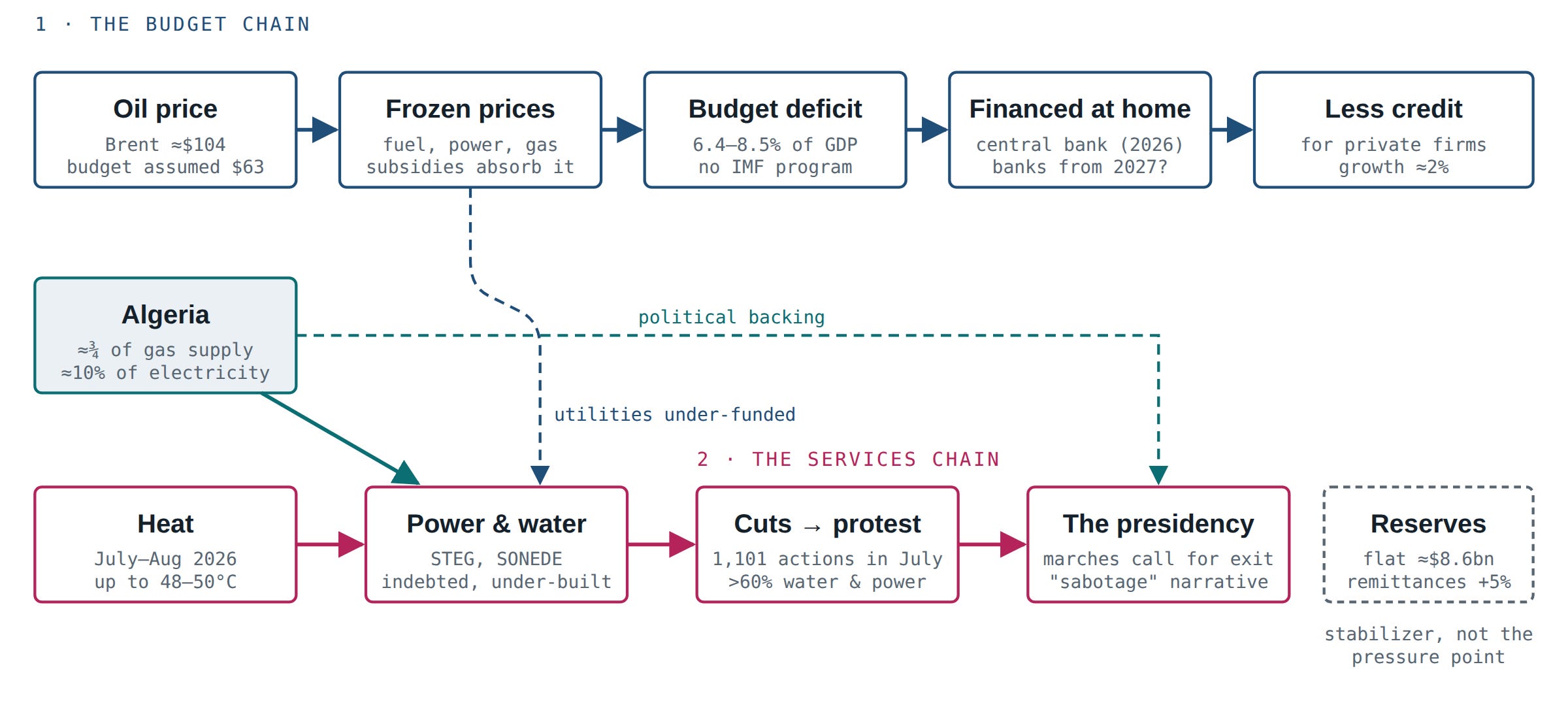
How the squeeze works. Top: the oil shock lands on the budget, and the budget leans on the central bank. Bottom: heat and underfunded utilities turn into protest. Algeria supplies gas and power and backs the government. Reserves have cushioned the shock so far.
Why Does Tunisia Keep Losing Power and Water?
We get almost all our electricity from natural gas. When the summer heatwave hit, everyone cranked up their AC at once, so electricity demand reached record levels. The national power company couldn’t produce enough electricity to meet that demand. Tunisia has been slow to build new power plants, so there wasn’t enough spare capacity to handle the surge. To prevent the entire system from shutting down, the utility company cut power in different neighborhoods, one by one.
The water shortages are partly due to years of drought and old pipes that badly need repairs. Water levels in many of our reservoirs have fallen dangerously low during recent droughts. But even when we do have water, a lot of it never makes it to our homes. Some estimates suggest that nearly half of the water in the distribution network is lost before it reaches customers because of leaks and other problems. The electricity cuts made things worse because water pumps also need power to work.
As the power cuts continued into August, more people took to the streets. Some just wanted their electricity and water back, while others called for President Kais Saied to resign and release political prisoners. Instead of acknowledging the problems, Saied accused people of deliberately cutting the power to make him look bad, without providing any evidence. His critics argued that the government had neglected the country’s electricity and water systems for years.
What Are The Economic Causes of Tunisia’s Infrastructure Crisis?
Higher gas prices have been a hot topic for Americans this year, but for countries like Tunisia, those increases can also affect electricity supplies. Unlike our neighbors in Libya and Algeria, Tunisia doesn’t have huge oil reserves. We depend heavily on energy from other countries, especially natural gas from Algeria, so higher global prices hit us hard.
When Tunisia set its budget for 2026, the government expected oil to cost about $63 a barrel. But by September, disruptions to oil shipments near Iran in the Strait of Hormuz had pushed prices past $100. That left Tunisia with much higher fuel costs than expected when the government was already short on money.
The government keeps electricity prices low to help people afford their bills. These discounts are especially important for low-income families, but they’re expensive for the government. When fuel prices rise, it has to pay even more to keep electricity affordable. Meanwhile, the national power company doesn’t always collect enough revenue from customers to cover its costs, which leaves less money for repairs.
So why doesn’t the government just raise electricity prices? It’s worried about how people will react. In 1983, the government tried to double bread prices, which sparked protests across Tunisia. Dozens died before the government reversed the increase in January 1984. Today’s leaders don’t want to risk another crisis like that.
How Is the Tunisian Government Managing its National Debt?
When a country is short on money, it can ask the International Monetary Fund (IMF) for a loan. In 2022, Tunisia reached an initial agreement for $1.9 billion, but the IMF wanted some changes before it would approve the loan. It wanted Tunisia to limit spending on government workers’ pay and gradually reduce how much the government paid toward people’s electricity and fuel bills.
That would mean higher bills for families already struggling to get by. The IMF proposed extra financial help for these families, but President Saied argued that the changes would still hurt ordinary Tunisians as a whole. He rejected the terms in 2023, so the loan never went through.
Without that money, the government had to look elsewhere. In 2026, it passed a law that allowed the country’s central bank to lend it up to 11 billion Tunisian dinars (about $3.7 billion) without interest, with 15 years to pay it back. The government has also turned to local banks to cover expenses and pay off older debts.
But banks only have so much money to lend. The more they lend to the government, the less they may have for businesses. A clinic might struggle to get a loan for a new X-ray machine, or a restaurant owner might have trouble borrowing money to open a second location. Without loans, businesses may put off plans to expand or hire workers. That can hurt the economy and leave the government with less tax revenue.
All the while, the water and power companies still need money for repairs. The government might find enough loans to pay its debts, but that won’t fix a rusted pipe or turn the lights back on in our homes.
Will Tunisia Default on Its Foreign Debt?
Despite Tunisia’s financial problems, the country hasn’t run out of money to pay its foreign debts. In early September, it had enough foreign currency saved up to cover about three months of imports, such as fuel and food. There’s still a risk that Tunisia could fail to pay its debts in the future, but so far, it has kept up with payments, including a €700 million loan that came due in July 2026.
To protect that money, Tunisia limits how much people can send or spend abroad. Tunisians can’t freely transfer money to foreign bank accounts, and eligible residents can generally exchange only 6,000 dinars (roughly $2,000) a year for travel. Services like PayPal are also restricted. I’ve lived with these rules my whole life, and people from other countries are shocked when I explain them. I understand why the government wants to keep foreign currency in Tunisia, but these rules also make life harder for us.
We might keep scraping by with more loans, but that won’t fix the economy. It’s like giving someone pain medicine for a broken leg. The pain might ease, but the bone is still broken. It’s difficult to watch the government find ways to pay its debts while our water pipes and power lines still need repairs.
How Could Tunisia’s Economic Crisis Affect Other Countries?
Remember how I mentioned that Tunisia depends heavily on natural gas from Algeria? Some of that gas comes from an Algerian pipeline that crosses Tunisia on its way to Italy. Think of it like a toll road, except Algeria pays us partly in gas instead of money. During the first five months of 2026, Tunisia received about a third less gas through this arrangement than during the same period in 2025. That left us more dependent on other supplies.
Europe also has close ties to Tunisia through trade and migration. The European Union buys more than 70% of everything we sell abroad. Our coast also happens to be a departure point for migrants who try to reach Italy by boat. In 2023, the EU signed an agreement with Tunisia to help reduce unauthorized migration, and the number of migrants who have arrived in Italy from Tunisia has since dropped significantly. However, human rights groups have criticized European leaders for continuing to work with Tunisia on migration despite the government’s arrests of political opponents.
What is the Future Outlook for Tunisia’s Economy and Infrastructure?
Tunisia is a warning sign for the rest of the world. Climate change is making extreme heat more common, while governments everywhere are facing pressure to keep electricity and water affordable. Tunisia shows what can happen when a country puts off basic repairs for years, only for a summer heatwave to push its systems to the breaking point. Other countries could face similar problems if they wait until a crisis to act.
Tunisia may be able to avoid a major financial crisis over the next year if it continues to meet its debt payments and finds enough money to cover its expenses. Lower global energy prices could help, and additional loans might provide some relief. But neither would guarantee that the government has enough money left to repair the country’s electricity and water systems.
Paying debts on time doesn’t fix the problems at home. I worry about what the future holds for Tunisia if we continue down this path. The government might avoid a financial crisis, but that means little to families who still struggle to get reliable electricity and water. Until Tunisia invests enough in these basic services, millions of people will continue to live with the consequences.
Coming next: A closer look at Tunisia’s strict money rules, its changing political landscape, our complicated relationship with Algeria, and the role of the United States in North Africa.
Sources
This summer’s outages and protests
Euronews, “Tunisia marks Saied’s emergency measures anniversary amid deadly power crisis,” 25 Jul 2026.
L’Économiste Maghrébin, “Contestation sociale en Tunisie : l’eau et l’électricité au cœur de 60 % des mouvements en juillet,” 20 Aug 2026.
Kapitalis, “La tendance à la hausse des protestations se poursuit,” 19 Sep 2026.
AP, reporting on Tunisia’s summer protests, 20 Aug 2026.
Al Jazeera, “Antigovernment protesters take to Tunisia’s streets for second month,” 21 Aug 2026.
The National, “Soaring temperatures lead to deaths and power cuts in Tunisia,” 29 Aug 2026.
Sharan Grewal, “Tunisia’s summer of discontent,” Brookings, 10 Aug 2026.
TIMEP, “Power cuts, protests, and (lack of) policy,” 30 Jul 2026.
Health
WHO, Heatwaves (health topic page).
CDC, “Managing insulin in an emergency.”
Currency controls
Tourismag, “Tunisie : doublement du montant de l’allocation touristique, à 6000 dinars par an.”
Oil shock, budget and debt
Sunday Guardian, “Brent crude oil price today (September 25),” 25 Sep 2026.
Washington Post, “Trump rejects Iran’s proposal to reopen Strait of Hormuz, restart peace talks,” 26 Sep 2026.
WebManagerCenter, “Loi de Finances 2026 : comprendre le budget,” 15 Dec 2025.
ilboursa, “Compensation des carburants : plus de 2 milliards de dinars économisés entre 2024 et 2026,” 21 Nov 2025.
L’Économiste Maghrébin, “Choc pétrolier : comment la guerre en Iran fait dérailler le budget,” 22 May 2026.
TAP, report on Fitch’s affirmation of Tunisia at B-, Sep 2026.
African Manager, “Fitch rating: behind affirmation and cost of money printing,” Sep 2026.
Ministry of Finance, 2026 state budget summary (public debt estimate).
IMF, “IMF staff reaches staff-level agreement on an Extended Fund Facility with Tunisia,” 15 Oct 2022.
North Africa Post, “Tunisia: Kais Saied lambasts rating agencies,” Oct 2021.
TIME, coverage of the Tunisian bread riots, Jan 1984.
La Presse de Tunisie, “Budget 2026 : la Banque centrale prêtera 11 milliards de dinars à l’État,” 16 Oct 2025.
Central Bank of Tunisia Working Paper 1-2024 (Bouaziz & Salem), reported by African Manager.
La Presse de Tunisie, “Le paradoxe d’une liquidité bancaire record et d’un crédit au secteur productif en recul,” 14 Jun 2026.
News Tunisia, “Tunisia repays TND 2.35 billion international bond,” 14 Jul 2026.
Reserves and lenders
L’Économiste Maghrébin, “BCT : les avoirs nets en devises atteignent 25,4 Mrds de dinars ou 110 jours d’importation,” 11 Sep 2025.
Central Bank of Tunisia daily reserve figures for 14 and 25 Sep 2026, as republished by Tunisian financial media.
News Tunisia, “Remittances and tourism revenues exceed TND 11.6 billion by end-August,” Sep 2026.
Ecofin Agency, “Tunisia taps Afreximbank for fresh $500m,” Jun 2026.
News Tunisia, “The Arab Monetary Fund grants Tunisia a $312 million loan,” 7 Jul 2026.
European Commission, EU trade relations with Tunisia (export share).
Power, water and prices
ONEM / Ministry of Industry, Mines and Energy, “Conjoncture énergétique,” May 2026.
Business News, “Énergie : 66 % de dépendance…” (ONEM data), 15 Sep 2026.
Maghreb Emergent, “Tunisie : le forfait fiscal sur le transit du gaz algérien en baisse de 33 %” (ONEM data), 2026.
La Presse de Tunisie, on the Borj El Amri (Mornaguia) power plant, 18 Aug 2026.
La Presse de Tunisie, on electricity production and peak demand, 20 Jul 2026.
La Presse de Tunisie, “Barrages : le taux de remplissage a atteint 67 %,” 2 May 2026.
La Presse de Tunisie, “Tunisie : jusqu’à 50 % des pertes d’eau sur le réseau de la SONEDE,” 26 Feb 2025.
Ecofin Agency, “Tunisia food inflation climbs in August 2026,” Sep 2026.
Algeria and partners
Ecofin Agency, “Algeria to maintain power exports to Tunisia despite summer peak demand,” 2026.
RFI, report on President Tebboune’s address to parliament, 30 Dec 2025.
Euronews Arabic, on Tebboune’s remarks about Tunisia, 31 Dec 2025.
TAP, on the Tunisia–Algeria defense cooperation agreement, Oct 2025.
Anadolu Agency, on Tebboune’s response to the leaked “secret military agreement,” 2025.
Middle East Eye, “’Vassalage’: deepening Tunisia–Algeria ties spark mounting scrutiny and backlash,” 2026.
Anadolu Agency, “Algeria and Tunisia agree to extend gas deal to 2027,” Jun 2020.
Agenzia Nova, “Gas flows from Algeria to Italy slightly down via pipeline, but LNG growth,” 2026.
Radio Algérie, on the 2026 finance law’s oil price assumptions.
Rigzone, “Oil at $100 promises boon for Algeria,” 14 Mar 2026.
European Commission, “European Union and Tunisia: political agreement on a comprehensive partnership package,” 16 Jul 2023.
Washington Institute, “China’s presence in Tunisia: how far has it come?” Apr 2023.
Nawaat, “Migration: Tunisians continue to leave despite growing death toll and tighter controls,” 20 Sep 2026.
UNHCR Italy data, reported by CDE, “Migrant arrivals to Italy fall 30% in first half of 2026.”
DGAP, “Two years in, the impact of the EU–Tunisia deal on migration is overstated,” Jul 2025.